

Issue 1 · September 2026
The Second Look
Machines, money and minds

Where the Doubt Went
In the first week of September Open AI released a model, GPT-6 Astra, which it says has crossed its own “Critical” threshold for cybersecurity capability, and shipped it anyway, wrapped in monitoring and deployment controls. Anthropic had done something similar two days earlier, releasing Claude Fable 5.1 broadly and holding Mythos 5.1 back for trusted hands in cybersecurity and the life sciences. On 8 September the OECD published PISA 2025 and reported that fifteen-year-olds across the developed world have lost ground in reading and mathematics, with the losses falling hardest on evaluating information, connecting sources, and resisting what the report calls hasty reading. I read the three stories on the same morning and have not been able to separate them since.
The two laboratories are telling one story from opposite ends. Their models are now capable enough that their makers no longer trust the model’s own account of what it can do, so the safeguard lives outside it: a watcher, a gate, a person deciding who may ask. This is the argument Ken Wenger and I have made in Cognitive Information Theory since 2022. A system that carries its uncertainty as a single number, a confidence score, cannot tell a world that is random from a world that is undecided; the information that would distinguish them was thrown away when everything was compressed to one figure. Such a system does the only thing it can do. It commits. Doubt, if it is to exist at all, has to be built as a second system that watches the first. Every “Critical” label and every trusted-access tier is an admission that the first system cannot be asked to doubt itself, and I take some satisfaction in watching the largest laboratories in the world arrive, by their own route, at that conclusion.
The PISA result is the human half of the same picture. Evaluating information, connecting sources, resisting hasty reading: these are not academic skills. They are the second system, the part of a mind that pauses over a plausible answer and asks where it came from. The machines cannot supply that faculty, and we are letting our children lose it in the same decade. The Bocconi study with OpenAI, published on 27 August, was the most hopeful thing I read all month and also the most double-edged. Students given ChatGPT wrote with more coherence and quality; students trained in causal reasoning produced more original work and questioned more assumptions; students given both gained most broadly. The tool improves the answer; the training improves the question. Nobody is funding the second at anything like the scale they are funding the first.
The Price of a Mind
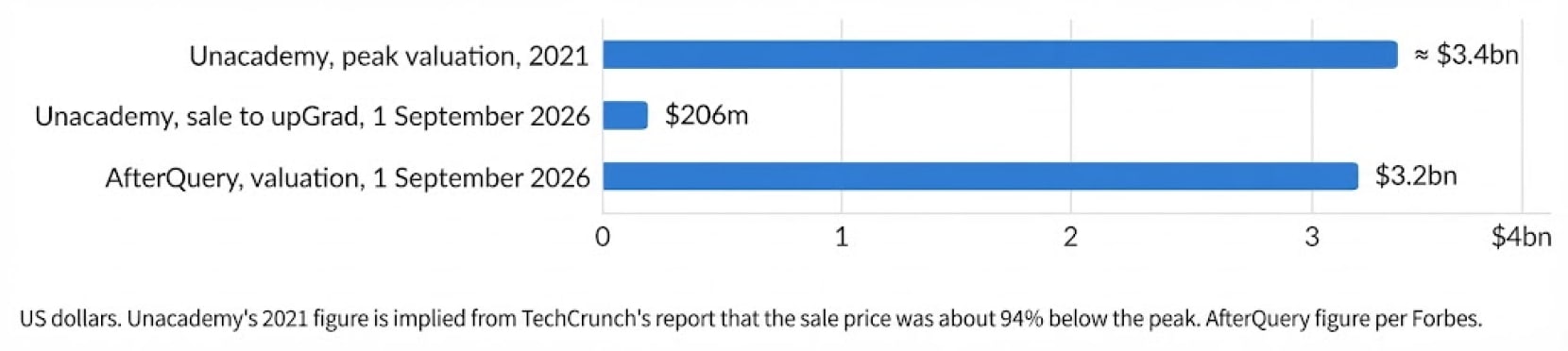
The market has noticed the same scarcity. In August global venture funding reached $42 billion, up 122 per cent on the year, with seven rounds above a billion dollars. Crusoe raised about $3 billion at a $30 billion valuation to build the power and compute the models run on. AfterQuery became Y Combinator’s fastest unicorn, at $3.2 billion, by supplying the laboratories with high-end human reasoning: expert judgement, packaged and sold by the batch. The same week NVIDIA agreed to pay $12.93 billion for Hugging Face, the commons on which open models are built. Read together these are not three bets on AI. They are one bet on the three scarce inputs, energy, the commons and careful human thought, and only the last is something PISA says we are producing less of. When I built my first company I would not have predicted that human reasoning would acquire a spot price, or that the price would rise as the supply fell. It has, and the founders who saw it first are being rewarded at a speed I find hard to look at without unease.
The unease has a source. On 1 September Unacademy sold to upGrad for about $206 million, 94 per cent below the valuation it carried in 2021. Nothing about the company’s product changed as much as the number did. This is the asymmetry I have written about before: valuations climb in small, hard-won steps and fall in an afternoon, and a founder who confuses the number with the business learns the difference at the worst possible moment. AfterQuery stands at $3.2 billion this month. Unacademy stood at roughly the same figure five years ago. They are not the same company, but the same arithmetic applies to both.
A Country That Prefers to Keep What It Has
Canada’s contribution to the month was a tariff war and a cheque. On 21 August the Prime Minister announced that Washington would put a 50 per cent tariff on roughly C$28 billion of Canadian goods and that Ottawa would answer dollar for dollar. On 28 August the counter-tariffs followed, on C$27.6 billion of American imports, together with a C$7.5 billion package for workers and businesses. I have lived and worked in Britain, the United States and Canada, and of the three Canada has always seemed to me the least entrepreneurial: a mineral, resource and heavy-industry economy with a handful of brilliant exceptions, Waterloo among them. So I read the package for its instincts rather than its headline, and the instincts are plain.
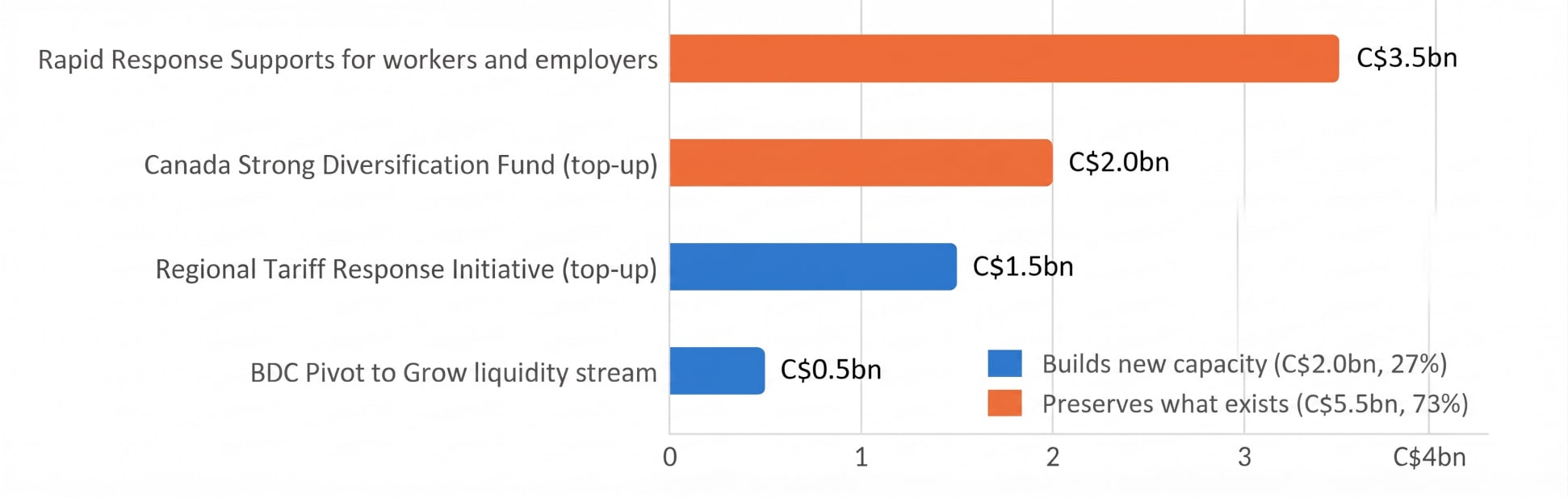
By my split, about C$2 billion of the C$7.5 billion builds new capacity: the enlarged Regional Tariff Response Initiative, which will give a southern Ontario firm up to C$3 million in non-repayable support for automation and new markets, and a new C$500 million liquidity stream at BDC. The remaining C$5.5 billion preserves what already exists: C$2 billion for shovel-ready capital maintenance under the Canada Strong Diversification Fund and C$3.5 billion for retention and retraining, with the large-enterprise loan facility and the auto remission scheme alongside, neither of them new money, both of them built for incumbents. Then, on 3 September, C$4.7 billion for VIA Rail to buy 313 carriages from Alstom, built in Thunder Bay and La Pocatière, supporting nearly 700 jobs.
The strongest case against my reading is a good one and deserves its full weight. A tariff shock is precisely the moment to preserve payrolls; a government that let assembly plants close in order to fund seed rounds would deserve to lose, and the RTRI money in Nova Scotia is already buying CNC machines for 27 businesses and organizations. Digital Transformation Canada, launched on 3 September with the promise to use federal procurement as an anchor customer for Canadian AI companies, is the most useful signal a domestic founder has had from Ottawa in years, and the new data-centre principles say out loud that compute must be built at home. All of that is true. None of it changes the ratio.
A quarter of the money looks forward and three quarters looks back, and when the same instinct is applied by the same institutions for decades you get the economy Canada has. The country is not short of talent or of capital. It is short of the belief that the new thing is worth more than the old one, and there is no programme that buys that.
I do not know how to legislate belief. I do know what a country’s largest cheques tell its founders about where they stand, and this month the largest cheques went to carriages and capital maintenance.