

The Dictionary Game
An observation on dyslexia, dysgraphia, standardised education, and the partial liberation that artificial intelligence has begun to offer
Damian Fozard
I distrust the celebration of dyslexia. The much-circulated list of famous dyslexics, Einstein and Churchill and Branson, da Vinci and Spielberg, has done a quiet harm to those who are dyslexic without an IQ at the upper tail of the distribution. It tells the wrong story. It treats a learning difference as a chrysalis from which a polymath or a self-made billionaire is bound to emerge, given the right encouragement. Most do not. Most carry the difference into adulthood as a load to manage, with compromise and limitation and a constant low-grade effort of compensation that the people around them never see. The famous list flatters the few and ignores the many, in the way that lists of outliers usually do.
I am one of the fortunate: I had a great deal of support. I was not diagnosed until my second year at university, and then by accident, almost 14 years after I should have been, and by then I had built a life that suited my mind. I think visually and mathematically, and had limited the impact of the thing I could not do well. It turned out my school limitations mattered less in the work I chose than I had been led to believe they would. Before that, however, I was the cleverest child in the class one moment and the dumbest the next. This essay is about that distance, and about what is finally beginning to close it.
I. The Dictionary Game
When I was eight, my mother saw what was happening. The handwriting was bad. The spelling was worse. The reading was not improving at the rate the school expected, and I had begun to hate the lesson called English. She found me a tutor. He came on a weekday evening, after the school day had already done its damage, and the prospect was not appealing. Two extra hours of the subject I had come to dread, with a man I did not know, in a small room with a single lamp. I expected it to be the worst part of the week.
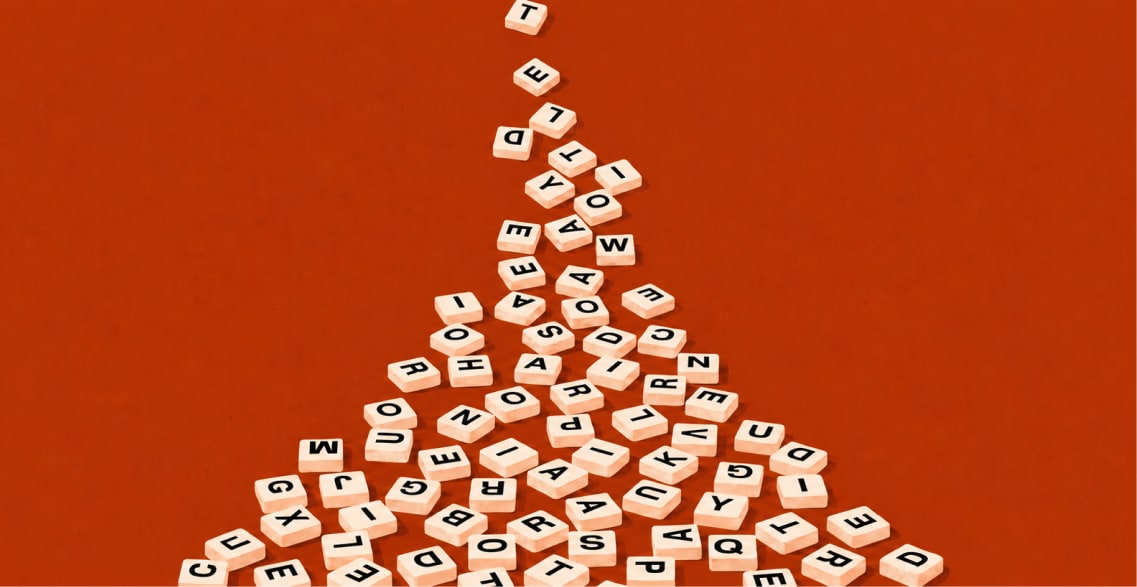
It was the best part. The tutor was a deep reader, an unhurried man, the kind of teacher who treated an eight-year-old as a working intelligence. He invented a game which I have remembered now for almost 50 years. Each day, I was to go to the dictionary, let it fall open at a random page, and find on that page one word that interested me. He did the same. Our sessions began with the words we had found. We talked about why they were interesting, where they came from, what they did, whether they had cousins, whether they had once meant something else. I did not know I was being taught. I thought I was talking about words I liked with someone who liked them too.
The dictionary game taught me to love language from the wrong end. Phonics, the method by which most children are taught to spell, requires the ear to decompose a word into the sounds that make it. I cannot do this, or I do it badly. My mind does not hear the composites; it hears the whole, and the whole is a shape, not a sequence. When I was younger I was treated as someone who simply had to try harder at hearing. I tried. The sounds did not separate.
It was only when my own son, who is dyslexic and dysgraphic as I am, came home from his school with a different vocabulary that I began to understand what had been wrong. The approach he was being taught is called morphology. You learn to spell by knowing what a word means at its root, by recognising the small units of meaning, the morphemes, that combine into longer words. Aqua is water, and so aquatic, aquarium, aqueduct are not unrelated noises but visible cousins. Photo is light, graph is to write, and photograph is a writing in light. For the dyslexic mind, this is a key that fits. Spelling becomes a problem of understanding rather than of decomposing sound. I still cannot place a comma reliably; my ear does not register the pause that the comma marks. I can, at last, spell with some confidence, by route of meaning rather than sound. I wish someone had taught me this when I was eight.
Dyslexia and dysgraphia are not single conditions with single solutions; they are families of differences, each one shaped by the particular child. The motto of the Delaware Valley Friends School, a world renowned school for children with learning differences, where both my children were educated and on whose board I had the privilege to serve, is that the staff meet the child where they are. It is a phrase that ought to be more famous than it is. It does not promise that every dyslexic child will produce another Einstein. It does not deny that the difference is real, or that it imposes a cost. It says only that the right educational response is particular to the person, not particular to the diagnosis. The Delaware Valley Friends model is unfashionable with policymakers for the same reason it works: it cannot be standardised.
II. The Standardised Years
The neurology of dyslexia did not change in the 1980s and 1990s. The vocabulary did. The Yale Center for Dyslexia and Creativity, the most authoritative academic home for the condition, was founded only in 2006. The British Psychological Society’s Division of Educational and Child Psychology did not publish its formal working-party definition of dyslexia until 1999. When I was at school in the 1970s, the language did not yet exist in the form that would have helped me; or it existed only in a handful of journals my teachers had never read. The diagnosis people received instead was the diagnosis their teachers improvised: slow, lazy, careless, distracted, or any number of less generous things.
Two perceptions sometimes follow from this history. The first is that dyslexia is a recent invention. It is not; it is simply a recent name. The second is that it was confined to certain families, certain backgrounds. The University of Oxford’s own history of the condition notes that since the 1960s the diagnosed population skewed strongly middle-class, and that the condition was for decades dismissed in some quarters as ‘a pseudo-medical diagnosis used by middle-class parents to explain their children’s poor performance’. In 2005, the Channel 4 Dispatches programme The Dyslexia Myth gave a national audience to that dismissal. As recently as 20 years ago, a serious public argument was being mounted that the condition itself was a fiction.
In the same window in which the diagnostic apparatus was being assembled, the educational systems on both sides of the Atlantic were moving in the opposite direction. The United States passed the No Child Left Behind Act in 2001. The United Kingdom had already introduced the national curriculum tests and the league tables built on top of them. The intent was unobjectionable: universal standards, regular measurement, accountability for results. The effect on children with learning differences was less so.
The Center on Education Policy found in 2006 that 71 per cent of American school districts had cut instruction time from at least one untested subject since the Act, with the deepest cuts in the districts already under pressure, the very places where undiagnosed learning differences are concentrated. By 2015, in New York State, only about 6 per cent of students with disabilities were meeting the state’s reading proficiency benchmark, compared with 31 per cent of all students. The College of Education at Lehigh University put the structural problem with admirable bluntness:
“NCLB calls for standardisation and accountability to reach common goals by all children, even those with disabilities. IDEA calls for an emphasis on the individual child with modifications and accommodations.”
The two laws were holding the same child by opposite ends.
The British picture rhymes. The House of Commons Education Committee concluded in 2017 that high-stakes testing was harming primary teaching and learning. A survey of school leaders found that 98 per cent considered Key Stage 2 SATs unsuitable for children with special educational needs; 56 per cent of pupils failing to reach the expected level at Key Stage 2 were assessed to be at risk of dyslexia or another specific learning difficulty. The instrument designed to lift the floor was being calibrated against the children whose floor was lowest by design.
Not every misfortune belongs at the door of standardised testing. There were honest reformers behind these policies, and a real problem they were trying to solve: schools that had quietly failed generations of poor and minority children while no one was counting. Political mandates rarely create only what they intend. In exchange for universal standards, the United States and the United Kingdom acquired a generation of teachers who taught to the test, who had less room to vary the pace and the method of a lesson, and who could less easily attend to the child whose mind worked sideways. The teachers I remember best, both the gifted ones and the indifferent ones, used a flexibility that the league-table era extinguished. The flexibility had sheltered some children and exposed others; the absence of it exposes nearly all.
Add to this the stigma. To be diagnosed as dyslexic in 1990 was, in most British schools, to be quietly removed from the path that led to A Levels and the universities beyond. The Disability Discrimination Act was passed in 1995. The Equality Act, which scaffolds the modern access arrangements of extra time and scribes, was not law until 2010. Before those, accommodations were ad hoc, headmaster’s whim, the gift of a sympathetic exam board. There were children in my generation who left education at 16 because no one had a word for what was wrong, and who would not have been allowed to use it kindly if they had.
III. From Grammarly to a Collaborator
I wrote my first book, Disbelief, over five years, beginning before any of the current generation of language models was usable as a writing tool and finishing just as they started to become viable. The tool I used through that period was Grammarly, which began as a spell and grammar checker and quietly transformed itself, over the course of my drafting, into something closer to a tutor. The change was not announced; one week the suggestions were more useful than they had been the week before, and a year later I noticed that I had stopped writing in the passive voice without anyone having to tell me again. It was Grammarly that had told me, repeatedly, until the lesson stuck. I was being trained by the tool I had paid to correct me.
I no longer use Grammarly. The current generation of assistants, the model behind Claude and the model behind ChatGPT and the others, can be configured to write with me rather than at me. They hold context. They remember the voice I am trying to write in. They argue with my framing when the framing is weak, and they push back when an analogy will not carry the weight I am asking it to. My human editor does the same things, more deeply and with judgement that no model has yet matched, and I would not write a book without one. Between drafts I now have a collaborator who is awake at three in the morning and patient with the same sentence on its fifth attempt.
The question that follows is the academic one. Is this cheating? It is being argued out, badly in some places and well in others, in schools and universities now. I am sympathetic to the difficulty of the question and unsympathetic to most of the answers. The right answer cannot be either an unconditional prohibition or an unconditional embrace, because the technology being objected to is not one thing. There is a meaningful distance between a student who types ‘Write an essay on the aspects of the Treaty of Versailles that made the Second World War inevitable’ and pastes the result, and a student who has worked through the secondary sources, built an argument over several drafts, and used a model to sharpen the prose and stress-test the argument. The first is rote production. The second is what literate adults have always done with editors, supervisors, and colleagues, only accelerated. The honest pedagogy distinguishes between them. The lazy pedagogy bans the tool and tests the student against a standard the world outside the school no longer enforces.
There is a further point that both sides miss. The fundamental cognitive skills, critical thinking, the analysis of evidence, the construction of an argument, the imagination of a counter-position, are not made obsolete by the model. They become more, not less, important. What the model erodes is the value of highly specific procedural knowledge: the syntax of a programming language, the placement of a comma in a long subordinate clause, the verb forms of the preterite in French. What it rewards is the capacity to specify well. To write good software with a modern model is not to be able to write good code; it is to be able to describe what the software ought to do, why it ought to do it, and how to know when it has. The model is not a development tool. The model is a developer. You need the skills to tell a developer what to build, not how to build it. The same is true for writing, for analysis, for design. The premium has shifted from the artisan’s hands to the architect’s drawing.
A student who wants to use a model well in 2026 needs the things schools were always supposed to teach, and which schools, under the pressures of standardisation, have for the last 20 years taught less and less of. The reordering will not be comfortable. The world outside the school will be unkind to graduates who emerge unable to use the tools the world is using. If the standardised test is a test of whether the student can produce, alone, what an adult would now produce with a model, it is testing for the wrong skill, badly.
IV. Taking It In
So far I have written about expression, the side of dyslexia that the world sees: the misspelt word, the bad handwriting, the comma in the wrong place. There is another side, less visible and in some respects harder. It is the burden of taking information in.
I find it exhausting to read large volumes of written material that contain a specific piece of information I need to extract. A medical letter, for instance, with a time and a date and a hospital and a department buried in three columns of disclaimer. The neurotypical reader scans, finds the appointment, files the rest. My mind goes the other way; it processes the whole, and the whole is heavy, and by the time I have read to the end the appointment has often blurred. The consequence is the kind of small daily mistake that the people around me sometimes find difficult to credit because the rest of me appears to function.
Two of mine, for the record. When I was 15 and sitting my O Level Geography, I arrived at the exam hall, found my seat, noticed that no one in the room looked familiar, and realised in the silence before the paper was distributed that I was in the right hall at the right time on the right day at the wrong school. I had read the letter; I had read it twice; I had committed the wrong school to memory and not seen the mistake. More recently, only a few weeks before I wrote this, I checked into a hotel for a conference, retired to bed pleased with my early arrival, and discovered the next morning that I was at a hotel with a similar name to the conference hotel but five kilometres away from the conference itself.
I have lived with this kind of mistake for 50 years. It is not a matter of intelligence; it is a matter of how my mind metabolises a page of text. I no longer make these mistakes when I am willing to use the help available to me. The help is to give the page to an assistant and ask ‘Tell me where I need to be, when, and how to get there.’ Five seconds. The page is reduced to the thing I needed from it. The shame I used to feel about needing the help has, slowly, drained out.
There is an objection here that I take seriously, because it comes from my own story. The dictionary game worked because it was effortful, and so did morphology. Robert Bjork’s phrase for this is desirable difficulty: the learning that sticks is the learning that cost something to acquire, and a tool that removes the cost may remove the learning with it. If the assistant reads the letter for me, I never learn to read the letter. I think the objection is right about children and wrong about me, and the line between the two is the line between a skill still being built and a skill that has had 50 years to be built and was not going to arrive. The tutor did not offload my reading; he made the effort bearable enough that I kept making it. For a child, the right use of the tool is that one, a way of staying at the page rather than a way of leaving it, and a school that lets the model do the decoding for an eight-year-old has removed the difficulty that was doing the teaching. For a man of 56 whose decoding is what it is, the offloading is not a shortcut past a skill. It is a ramp where the stairs were never going to be climbed.
A 2023 survey by Made By Dyslexia and Randstad found that 72 per cent of dyslexic respondents see AI tools as a valuable starting point for the kind of thinking they do well, and the same survey found a 50-point gap between the proportion of human-resources professionals who believed their organisations supported dyslexic employees (66 per cent) and the proportion of dyslexic employees who felt supported (16 per cent). Self-selected samples are not epidemiology. The British Dyslexia Association’s careful position is closer to the truth: artificial intelligence has real promise to remove barriers to education and employment, while also carrying privacy risks and inherited biases that the dyslexia community is right to watch. Sally Shaywitz of Yale, the most senior clinician working on dyslexia in English, has always argued that assistive technology is not a crutch but a means of cognitive offloading: it lets the dyslexic reader engage with content at the level of their reasoning rather than at the level of their decoding. The current generation of tools is the most powerful instance of that argument so far.
There are limits. Speech-to-text, which sounds like the obvious tool for a dysgraphic writer, has had what one longitudinal study reported as ‘mixed utility’ across users; it works for some and not for others, and the difference is not yet well understood. The peer-reviewed evidence base for using large language models with dyslexic students is young, small, and overwhelmingly qualitative. The fair description is that the tools are new, that the early signals are good, and that the people writing the policy will get it wrong in several directions before they get it right.
Where the Child Is
The Delaware Valley Friends School cannot be scaled to every dyslexic child in the world. The teachers it employs, the small classes it runs, the individual attention it makes possible, are not features of any standardised education system on either side of the Atlantic, and they will not be. For the great majority of children who learn differently, the schooling available is the schooling that the league tables and the testing regimes will permit. The tools which sit, by 2026, on every child’s laptop and phone have begun, quietly, to do some of what Delaware Valley Friends and my tutor and my morphology-trained son’s school did for the three of us. They meet the child where the child is, on demand, in the small private moments when the child is alone with the page that defeats them.
This is not a tidy conclusion. The same tools, in the same week, will be used by lazy students to produce work that demonstrates nothing, by lazy teachers to grade it, by employers to filter applicants on criteria they cannot articulate, by governments to surveil populations they distrust. The dyslexic child does not stand outside the wider question of what artificial intelligence does to a society; she stands inside it, and the question of whether she is freed by the technology or further constrained by it will be answered by people who do not know she exists.
The child has to be met where they are. The dictionary game met me where I was. Morphology met my son where he was. Grammarly, in its slow accumulation of small corrections, met the writer I was trying to become. The current generation of writing tools meets me where I am now, which is at 56, with a hatred of commas, and a great deal that I would still like to say.
More essays

The terrible job
Your first question

The evolution of complexity, entropy, and ambiguity in a perception system
What sport actually teaches

What AI reveals about human sentience, free will, and creativity

Assessing the Suitability of a Problem for AI

Entropy, ambiguity, and the evolution of the human mind

AI interviews well

The rise of AI consumerism: Living in a world of invisible algorithms

The mathematical principles of information

The future of AI and the path to artificial general intelligence
